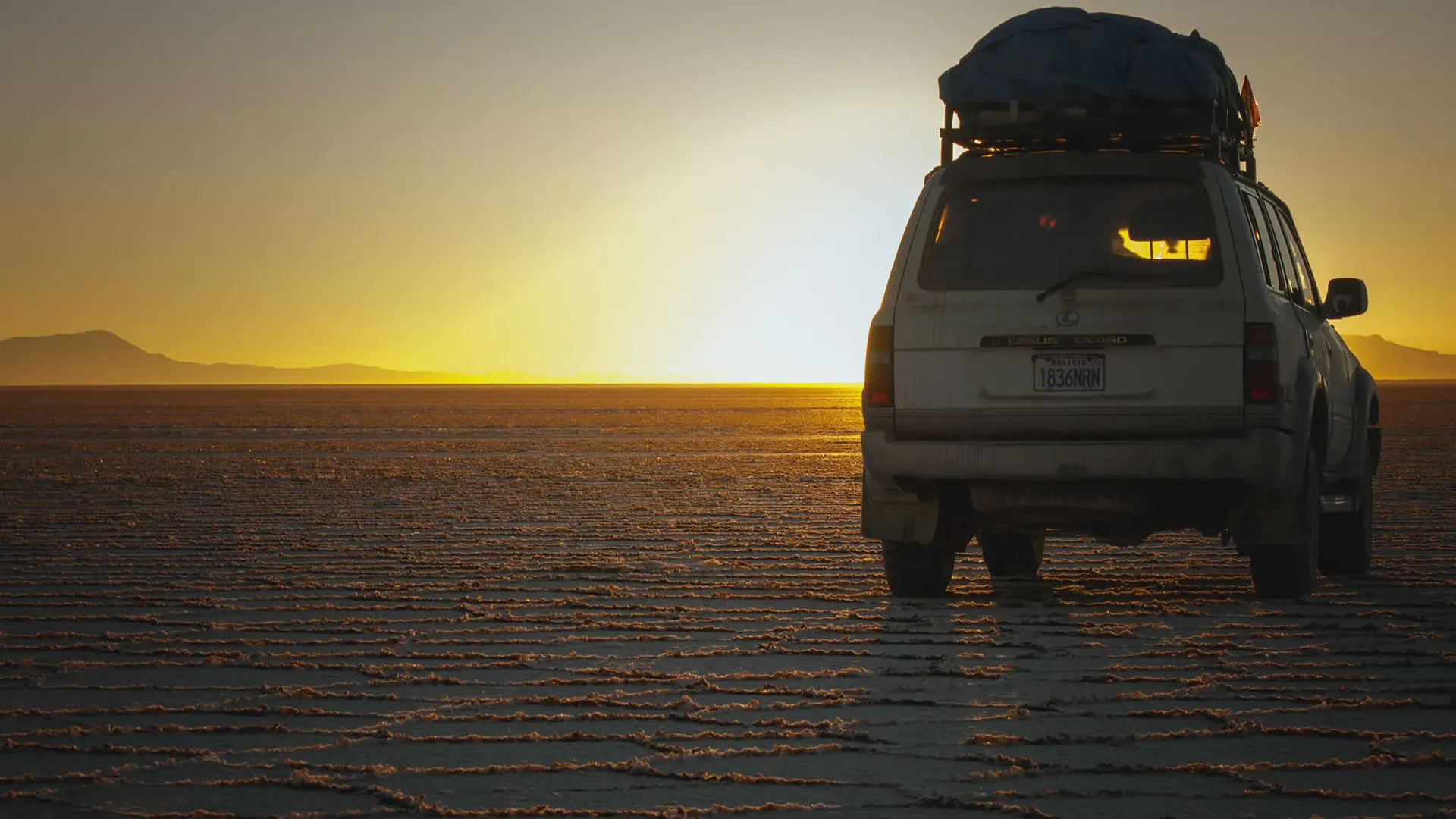
Verified by licensed Bolivian expedition directors and senior mountain guides.
Plan your San Pedro de Atacama to Uyuni tour with real border logistics, high-altitude safety protocols, vehicle checks, and private itineraries.
Traversing the Altiplano from Chile into Bolivia is one of South America's most demanding overland journeys. You leave the red sandstone valleys of the Atacama Desert behind. You climb abruptly through freezing mountain passes into southwestern Bolivia.
Choosing the right San Pedro de Atacama to Uyuni tour makes the difference between an uncomfortable trek and an extraordinary high-altitude expedition. Our field team runs this 500-kilometer desert crossing weekly. This guide provides exact border steps, vehicle safety standards, altitude protocols, and detailed route stages.
Route Overview and Expedition Timeline
A San Pedro de Atacama to Uyuni tour takes travelers across 500 kilometers of remote Altiplano terrain over three or four days. The journey begins at 2,400 meters in San Pedro de Atacama. It climbs past the Hito Cajón border post at 4,480 meters. Then, it peaks at 4,850 meters near the Sol de Mañana geysers. Finally, the route descends onto the Salar de Uyuni salt crust at 3,656 meters. Private 4x4 transport, extreme altitude acclimatization, and strict cash preparation are required for this crossing.
| San Pedro de Atacama to Uyuni tour | Total Distance: 480 to 520 kilometers (route dependent) |
|---|---|
| Maximum Altitude | 4,850 meters (Sol de Mañana geothermal field) |
| Average Duration | 3 days / 2 nights (standard one-way to Uyuni) |
| Border Checkpoint | Hito Cajón (Chile / Bolivia) |
| Primary Vehicle | Purpose-built 4x4 Toyota Land Cruiser |
| Coldest Point | Laguna Colorada basin (-15°C winter nights) |
Border Crossing Mechanics at Hito Cajón
The border crossing between Chile and Bolivia sits at Hito Cajón. The wind is fierce here, and the altitude hits 4,480 meters.
First, your Chilean transfer picks you up from your San Pedro hotel around 07:00. The driver takes you to the Chilean immigration office downtown. You present your passport and your PDI slip (Policía de Investigaciones). The officers stamp your exit paper.
Next, you drive 45 minutes up route 27 to the border. The pavement ends directly at the border line. Chilean territory yields to unpaved Bolivian gravel.
- San Pedro Downtown -> PDI Exit Stamp -> 45-min Ascent (Route 27)
- Hito Cajón Post <- Switch to 4x4 Toyota <- Bolivian Immigration (SIGEMIG)
At the Bolivian post, conditions are basic. Therefore, you must prepare your documentation beforehand:
- SIGEMIG Registration: Complete your digital pre-registration on the Bolivian immigration portal before leaving San Pedro. Print the receipt sheet. Border agents often reject phone screens when their generator power cuts out.
- Visa Requirements: Group I nationalities (most European countries, US, UK, Canada, Australia) receive a free 30-day stamp. Group II must pay $160 USD in cash. Bring unblemished, crisp bills issued after 2018. The immigration police will reject any bill with tiny tears or ink stamps.
- Eduardo Avaroa Reserve (REA) Entry: You must pay 150 Bolivianos (BOB) in physical cash per person at the park hut. You cannot use Chilean pesos, cards, or foreign currencies here.
After immigration clears your entry, you meet your Bolivian expedition driver. You switch luggage into your licensed 4x4 Toyota Land Cruiser and continue the San Pedro de Atacama to Uyuni tour.
Vehicle Standards and Expedition Safety
The southwest Altiplano contains no paved roads, fuel stations, or cell towers. As a result, vehicle reliability is your primary life-support system.
Low-cost shared operators often cut corners. They overload vehicles with six passengers plus luggage. In addition, their drivers skip basic mechanical maintenance.
We require purpose-built expedition standards on every private San Pedro de Atacama to Uyuni tour:
| Inspection Metric | Budget Shared Operator | Private Expedition |
|---|---|---|
| Vehicle Model | Aging Toyota Land Cruiser (1990s) | Maintained Toyota Land Cruiser 4x4 |
| Passenger Count | 6 passengers (cramped seating) | 2 to 4 passengers (window seats) |
| Emergency Oxygen | Rare or empty cylinders | Medical oxygen tank with regulator |
| Navigation Comms | Local road memory only | Garmin InReach satellite tracker |
| Driver Schedule | Extended hours, cooking duties | Dedicated driver with set rest breaks |
| Luggage Storage | Exposed roof rack under tarps | Dust-sealed interior or canvas roof |
| Spare Parts | Single spare tire, basic jack | Dual spares, high-lift jack, compressor |
Before departing Hito Cajón, our drivers lower tire pressures to roughly 22 PSI. This adjustment increases surface contact across sand patches.
Step-by-Step 3-Day Expedition Itinerary
Choosing a private San Pedro de Atacama to Uyuni tour allows you to dictate the pace. You arrive at isolated viewpoints long before crowded shared minivans pull up.
3-Day Route at a Glance (San Pedro de Atacama to Uyuni)
| Day | Route & Key Sights | Distance | Max Altitude | Overnight / End |
|---|---|---|---|---|
| Day 1 | San Pedro → Hito Cajón → Laguna Verde → Laguna Colorada | ~140 km | 4,850 m | Polques / Huayllajara |
| Day 2 | Siloli Desert → Árbol de Piedra → Altiplanic Lagoons → Salt Hotel | ~210 km | 4,550 m | San Juan / Colchani |
| Day 3 | Salar de Uyuni Sunrise → Incahuasi Island → Colchani → Uyuni | ~130 km | 3,656 m | Uyuni Town (Drop-off) |
Day 1: High Pass, Geothermal Basins, and Laguna Colorada
Starting the San Pedro de Atacama to Uyuni tour, you cross the border at Hito Cajón by 08:30. Within twenty minutes, you arrive at Laguna Blanca and Laguna Verde. Licancabur Volcano stands directly behind them at 5,916 meters. Because the wind picks up around mid-morning, the copper-mineral sediments churn up, therefore the water shifts from dull slate to emerald green.
- Hito Cajón (08:30)
- Laguna Blanca & Verde (09:15)
- Desierto de Dalí (10:45)
- Polques Hot Springs (12:00) [Lunch & 35°C Thermal Bath]
- Sol de Mañana Geysers (13:45) [4,850m Summit Point]
- Laguna Colorada (15:30) [Overnight nearby]
Next, your driver heads north across the Desierto de Dalí. Wind-carved rocks rise out of vast sand sweeps here. You continue past the thermal springs of Polques. The driver stops so you can soak in the natural 35°C pool while lunch is prepared.
Later, you climb to Sol de Mañana at 4,850 meters. Steam vents hiss boiling sulfur mist into the freezing air. You must step carefully around the unsecured mud cauldrons. The crust is unstable near their rims.
By late afternoon, you pull up to Laguna Colorada at 4,278 meters. Thousands of James's, Andean, and Chilean flamingos feed on red micro-algae in the lake.
You sleep nearby in a rustic mountain refuge at Polques or Huayllajara. Temperatures drop below -10°C here between June and August.
Day 2: The Siloli Desert and the Route of the Jewels
Your driver starts the engine early to warm the transmission fluids. Today, you cross the Siloli Desert. This high plateau features sharp gravel and wide fields of volcanic pumice.
First, you stop at the Árbol de Piedra. Wind-blown sand has eroded this sandstone formation into a fragile tree shape. Climb back into the Land Cruiser before the midday winds pick up.
- Siloli Desert Departure (08:00)
- Árbol de Piedra
- Lagunas Altiplánicas (Hedionda, Chiarkota, Honda)
- Ollagüe Volcano Lookout
- Salt Flat Rim (San Juan or Colchani)
Then, you follow the Route of the Jewels. These high-altitude lakes include Laguna Hedionda, Laguna Chiarkota, and Laguna Honda. At Laguna Hedionda, flamingos feed only a few meters from the rocky bank. Your private crew sets up lunch right by the water, away from large tour buses.
After lunch, you skirt the active semi-dormant Ollagüe Volcano. You observe active sulfur vents along its western flank.
Finally, you descend toward the edge of the salt flat. You spend the night in a hotel built from pure salt blocks in San Juan or Colchani. These rooms offer private heating, solar showers, and electric blankets.
Day 3: Salar de Uyuni Sunrise to Uyuni Town
You wake up at 05:00 while the desert is pitch black. Your driver navigates onto the salt flat by GPS.
You stop in the open flat to watch the sunrise. The morning light turns the white salt crust pale pink, then blazing gold. During the dry season (May to October), clean hexagonal salt patterns stretch in all directions. During the wet season (January to March), a thin layer of water mirrors the sky.
05:00 - Depart Salt Hotel in Dark
06:00 - Sunrise over the Salt Crust
08:00 - Incahuasi Island (Giant Trichocereus Cacti)
11:00 - Dakar Monument & Original Salt Hotel (Playa Blanca)
12:30 - Colchani Artisan Market & Salt Refining Yards
14:00 - Uyuni Train Cemetery & Town Arrival
Next, you drive to Incahuasi Island. This rocky outcrop is an ancient coral reef covered in giant Trichocereus cacti. Some plants stand over ten meters tall. You hike to the summit for a 360-degree view over the salt plains.
Afterward, you visit the Dakar Monument and the historic Playa Blanca salt hotel. Then, your driver stops at Colchani to show you traditional salt harvesting techniques.
The final stop is the historic Train Cemetery outside Uyuni town. British steam locomotives from the late nineteenth century sit abandoned on old mining tracks.
Your San Pedro de Atacama to Uyuni tour finishes in Uyuni town around 14:00. From here, you can catch an evening flight to La Paz or board an overnight sleeper bus.
Altitude Acclimatization and Health Logistics
Altitude sickness (soroche) is the main hazard on this San Pedro de Atacama to Uyuni tour. San Pedro sits at 2,400 meters, which feels comfortable. However, your San Pedro de Atacama to Uyuni tour climbs past 4,400 meters within two hours of leaving town.
Altitude Risk Profile:
San Pedro: 2,400m --> Baseline (safe)
Hito Cajón: 4,480m --> Rapid jump (High Soroche Risk)
Sol de Mañana: 4,850m --> Peak elevation (Short stops only)
Salar de Uyuni: 3,656m --> Gradual recovery
To avoid acute mountain sickness during the San Pedro de Atacama to Uyuni tour, follow our operational medical guidelines:
- Acclimatize in San Pedro: Spend at least 48 to 72 hours in San Pedro de Atacama first. Take day tours to the high lagoons (Lagunas Altiplánicas at 4,200m) to help your body adapt.
- Preventative Medication: Consult your doctor about taking Acetazolamide (Diamox). Most travelers take 125mg to 250mg twice daily, starting 24 hours before leaving San Pedro.
- Hydration Metrics: Drink between 3 and 4 liters of water each day. The dry desert air accelerates dehydration through breathing.
- Alcohol Avoidance: Do not drink alcohol during your final two nights in Chile. Alcohol suppresses respiration and worsens nighttime hypoxia.
- Medical Equipment: Confirm that your vehicle carries a functioning pulse oximeter and a full oxygen tank with a clean mask.
Pack List and Gear Management
The Altiplano brings severe thermal shifts. Day temperatures can reach 20°C under intense UV light, then drop to -15°C at night. Pack your gear for the San Pedro de Atacama to Uyuni tour using this checklist:
[ ] Thermal base layers (merino wool tops and bottoms)
[ ] Heavy fleece mid-layer and windproof down parka
[ ] Category 3 or 4 UV sunglasses (essential on the salt flat)
[ ] High-SPF sunscreen (SPF 50+) and zinc lip balm
[ ] Headlamp with spare AAA batteries
[ ] Portable power bank (20,000 mAh minimum)
[ ] 300 Bolivianos cash per person in small denominations
[ ] Sturdy waterproof hiking boots
[ ] Quick-dry microfiber towel and wet wipes
Keep your electronics warm at night. Freezing temperatures drain lithium-ion batteries in a few hours. Keep your phone, camera batteries, and power banks inside your sleeping bag or jacket pocket overnight.
Booking Your Expedition
Crossing the southwestern desert into Bolivia requires strict safety planning. However, budget group tours cut prices by overloading old vehicles and skipping emergency gear.
For safety and comfort, book our private san-pedro-de-atacama-uyuni-private-tour. Our private expeditions give you:
- Dedicated Toyota Land Cruisers with window seats for every traveler.
- Experienced, non-driving tour leaders alongside expert local drivers.
- Continuous satellite tracking and on-board medical oxygen.
- Comfortable salt hotel properties with reliable heating and hot water.
- Clear assistance through border customs at Hito Cajón.
Reserve your private San Pedro de Atacama to Uyuni tour at least six weeks ahead, especially for travel between June and September.