This guide is written by our Lead Expedition Director and verified by licensed local guides operating daily 4x4 routes across the Southwest Circuit.
Choosing how to explore the Salar de Uyuni and the surrounding Southwest Circuit of Bolivia is the single most important decision of your trip. The salt flats sit at an elevation of 3,656 meters (11,995 feet), and the multi-day route through the Eduardo Avaroa National Reserve climbs to nearly 4,900 meters (16,076 feet). This is a remote, high-altitude desert environment with extreme temperatures, unpaved washboard tracks, and virtually no cellular service.
The choice between a private 4x4 expedition and a budget shared group tour is not merely a question of saving money. It directly impacts your physical safety, your sleep quality, your health at high altitudes, and the creative control you have over your photography.
This guide provides an objective, operational breakdown of private vs shared Uyuni tours to help you make an informed decision.
Private vs Shared Uyuni Tour: Quick Verdict
If you are looking for a fast comparison, here is the direct operational reality:
A private Uyuni tour provides a dedicated, well-maintained Toyota Land Cruiser 4x4 for your travel party, a professional driver operating under strict rest guidelines, an English-speaking guide, and overnight stays in comfortable private hotels with heating and hot water. You control the itinerary, departure times, and photography stops.
A shared Uyuni tour packs six travelers from different booking sources into a single vehicle with one driver-guide (who speaks only Spanish). It follows a rigid, hurried schedule, uses basic, unheated shared dormitories (refugios) with shared cold showers, and carries a significantly higher risk of driver fatigue and vehicle maintenance issues.
Direct Operational Comparison
Vehicle Safety and Maintenance Standards
The Southwest Circuit of Bolivia is notorious for punishing terrain. Corrugated dirt roads, deep volcanic sand, and salt crusts cause severe wear and tear on vehicles.
Private Tour Vehicles
Private operators use purpose-built, late-model Toyota Land Cruiser 4x4s. These vehicles undergo rigorous mechanical safety checks before and after every single expedition. Because you only travel with your selected group (typically 2 to 4 people), the vehicle is not overloaded. This leaves ample room inside for your daypacks, while heavy luggage is securely strapped and double-tarped on the roof rack.
More importantly, reputable private operators equip their vehicles with essential safety gear:
Shared Tour Vehicles
Shared tours operate on razor-thin profit margins. To make these trips financially viable, operators must fill every seat. You will sit three-across in the middle and back rows of the 4x4 for up to 8 hours a day.
Because budget vehicles are heavily used with minimal downtime between trips, suspension systems, tires, and brakes are often worn down. Seatbelts in the rear seats are frequently non-functional or cut out entirely to make room for seat covers. It is highly uncommon for a budget shared tour vehicle to carry emergency oxygen or satellite tracking devices. If a breakdown occurs, shared tour drivers must rely on passing vehicles for assistance, which can result in hours of waiting in freezing desert winds.
Driver Fatigue and Rest Schedules
Driver fatigue is the leading cause of transport accidents in the Uyuni region.
[Shared Tour Driver Schedule]
Wake up at 5:00 AM -> Pack vehicle -> Drive 8-10 hours -> Cook dinner -> Sleep 4-5 hours -> Repeat
High risk of fatigue-related safety incidents on unmarked desert tracks
[Private Tour Professional Schedule]
Wake up at 7:00 AM -> Professional breakfast -> Drive regulated hours -> Hand off to separate Guide -> Sleep 8+ hours
Low risk; driver focuses solely on road safety while guide manages logistics
On a shared tour, your driver is a jack-of-all-trades. They must navigate the trackless desert, cook your meals at the basic refugios, load and unload heavy luggage, and perform emergency mechanical repairs. These drivers often get only 4 to 5 hours of sleep per night before starting another long day of driving. The pressure to maintain a tight schedule can lead to unsafe driving speeds on corrugated dirt roads.
On a private tour, labor is divided. You have a professional driver whose sole responsibility is the safe operation of the vehicle. A separate, licensed bilingual guide manages the logistics, meals, check-ins, and sightseeing. Private operators enforce strict driver rest schedules, ensuring your driver is fully alert, well-rested, and drives at safe, controlled speeds.
Accommodation Quality: Refugios vs. Private Salt Hotels
The high-altitude desert of the Southwest Circuit experiences extreme temperature drops. During the dry season (May to October), night temperatures regularly plunge to -15°C (5°F) or lower.
Shared Tour Accommodations (The Refugios)
Shared tours stay in basic, community-run concrete or brick shelters known as refugios.
Private Tour Accommodations (Premium Salt Hotels & Eco-Lodges)
Private tours utilize comfortable, well-engineered hotels built directly on the edge of or near the salt flats.
[Hotel Palacio de Sal / Luna Salada]
├── Private Heated Rooms & En-suite Bathrooms
├── 24-Hour Electricity & High-Speed Wi-Fi
└── Hot Showers & Gourmet Dining Options
```
On your first night, you will typically stay at premium salt hotels such as Palacio de Sal, Luna Salada, or Cristal Samaña. These hotels feature walls, tables, and beds constructed entirely of salt blocks. They offer:
On the second night of the multi-day loop, private tours move deeper into the desert, utilizing comfortable eco-lodges like the Tayka Hotels (such as Tayka del Desierto or Tayka de Piedra). While more remote, these lodges still provide private heated rooms, private bathrooms, and hot showers—luxuries that are completely unavailable on shared itineraries.
---
Photographer Stop Flexibility and Crowd Avoidance
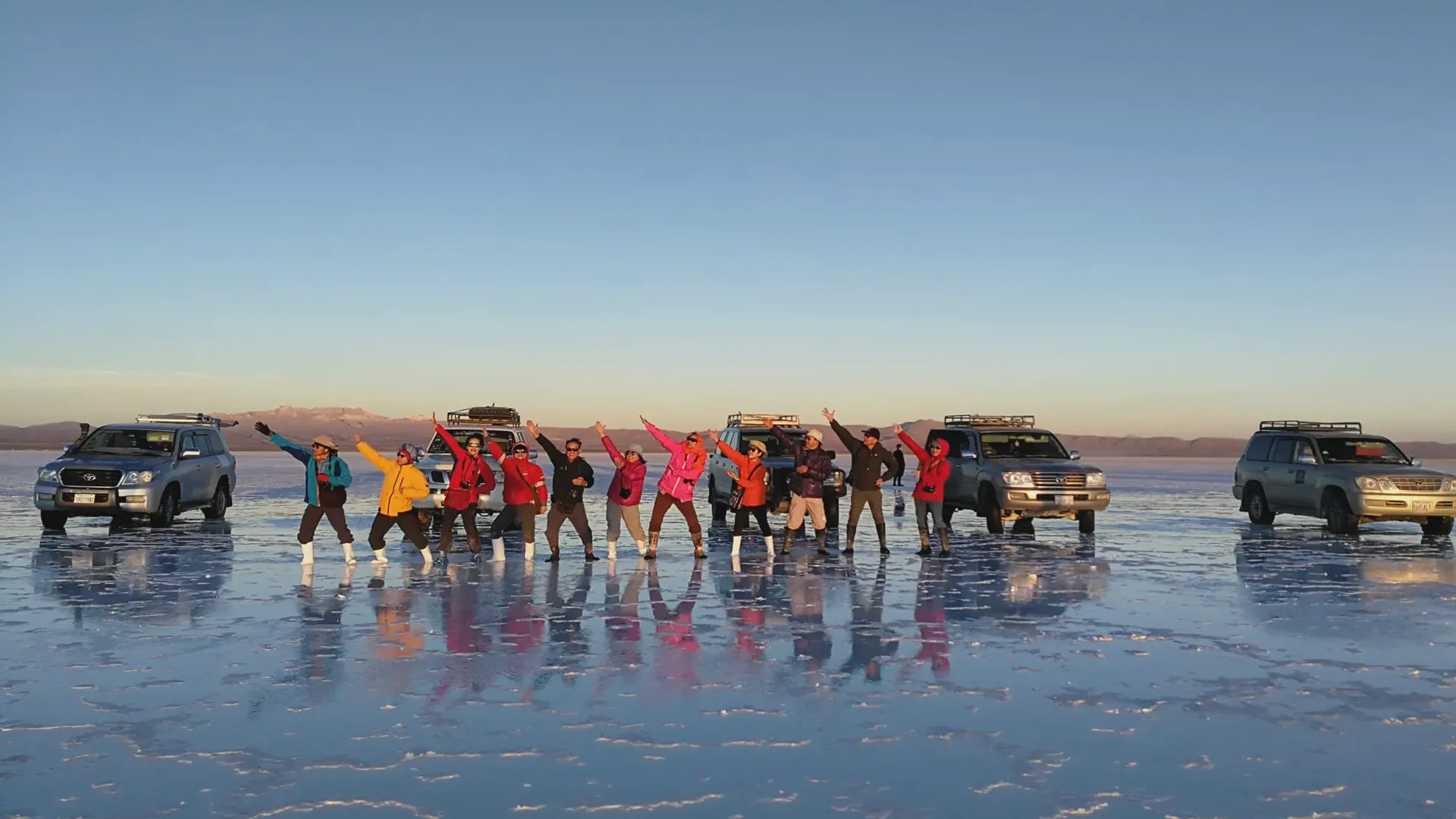
The Salar de Uyuni is a landscape defined by light, perspective, and vast horizons. Capturing the perfect shot requires patience, specific lighting conditions, and the absence of other tourist vehicles in your frame.
The Shared Tour Timeline
Shared tours follow a rigid, synchronized conveyor-belt itinerary. Every shared vehicle departs Uyuni at roughly the same time (around 10:00 to 10:30 AM) and visits the Train Cemetery, Colchani salt processing village, and the salt flats in the exact same sequence.
If you find a stunning location and want to wait 45 minutes for the light to shift, you cannot do so. The driver must keep moving to reach the next lunch stop or refugio before nightfall. You will constantly share your photo spots with dozens of other travelers, making clean landscape shots difficult to capture.
The Private Tour Advantage
A private tour gives you complete creative control over your schedule.
---
Reaching Uyuni: Transit Logistics
Before your tour begins, you must travel from La Paz to the town of Uyuni.
Flight Option (BoA)
The fastest and most comfortable method is a domestic flight with BoA (Boliviana de Aviación) from El Alto International Airport (LPB) to Uyuni Airport (UYU). The flight takes approximately 45 to 60 minutes.
Note: Flights can occasionally be delayed or canceled due to high winds in El Alto or Uyuni. We recommend arriving in Uyuni the day before your tour starts to build a buffer into your itinerary.
Overnight Bus Option (Todo Turismo)
The primary overland option is the overnight tourist bus. Todo Turismo is the gold standard for this route.
Immigration and Bureaucracy
If you are entering Bolivia from Chile (via the San Pedro de Atacama crossing) or flying directly into the country, make sure you have completed your SIGEMIG digital immigration pre-registration online. Depending on your nationality (such as US citizens), you may need to pay a visa fee (currently $160 USD in crisp, unblemished bills) at the border or airport.
---
Which Tour is Right for You?
Choose a Shared Tour If:
Choose a Private Tour If:
---
Recommended Expeditions
To experience the Salar de Uyuni with professional logistics, safety-checked 4x4s, and experienced guides, we recommend booking one of our curated itineraries:
---
Frequently Asked Questions
What is the price difference between private and shared tours?
A shared 3-day tour typically costs between $150 and $250 USD per person. A private 3-day tour ranges from $600 to $1,200+ USD per person. The price of a private tour decreases per person as you add more travelers to your private group (up to 4 passengers per vehicle).
Are shared tours safe?
While many travelers complete shared tours without incident, they carry a higher statistical risk of vehicle breakdowns, driver fatigue, and lack of emergency oxygen. If you choose a shared tour, research the operator carefully and verify that the vehicle has functional seatbelts before departing.
Can I see the mirror effect on a shared tour?
Yes, but with limitations. During the wet season (January to March), water covers portions of the salt flats. Shared tours will visit the wet areas, but they must stick to a strict timetable. If the weather is overcast or windy, you cannot wait for the conditions to clear. A private tour allows you to wait for the wind to drop to capture the perfect reflection.
Is English spoken on shared tours?
Almost never. Shared tour drivers are local Bolivians who speak Spanish. If you want an English-speaking guide on a shared tour, you must request one in advance for an extra daily fee, and they will occupy one of the six passenger seats in the 4x4. Private tours include a dedicated, bilingual guide as a standard feature.
How do toilets work on the Southwest Circuit?
Outside of the hotels, toilets are basic, low-pressure flush systems managed by local families. You must pay a small entry fee (usually 2 to 5 BOB) to use them. Always carry your own toilet paper and hand sanitizer in your daypack, as these are rarely provided.